Thursday, December 31, 2009

Audi O Sports Car Concept is fuel efficient diesel/electric hybrid drivetrain


Audi O Sports Car Concept

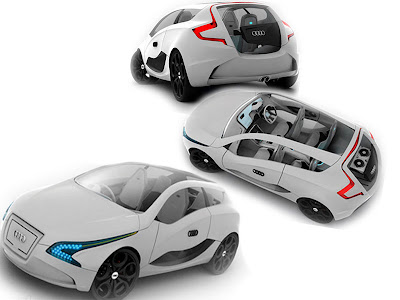
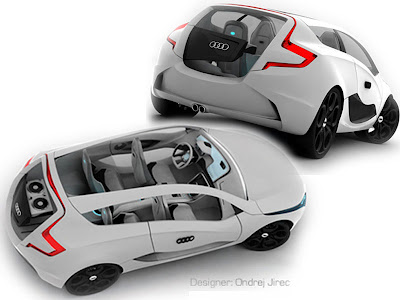
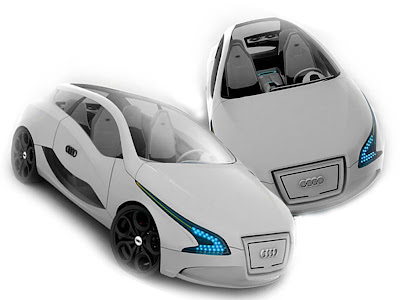
The Audi O concept was designed to fuse a powerful and innovative audio system with a stylish and sporty four-seat hatchback. The exterior design uses several Audi trademark styling themes, especially at the front where the square grille sits neatly between the LED headlights.
Audi O Sports Car Concept

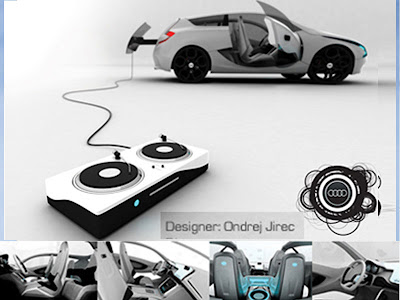
The doors feature glass windows running along the bottom edge which provide an interesting shape to the profile of the car. At the rear of the car the pullout door echoes the design of the squared off Audi grille. The 2008 Audi O concept was designed by Ondrej Jirec, a design student from the Czech Republic who is beginning studies at the Art Center College of Design, Pasadena, California in 2008.
Audi O Sports Car Concept

The interior of the Audi O concept is bright and airy thanks to a full length panoramic roof which floods the cabin with light. Inside, the passenger compartment has been separated from the engine compartment by a double firewall to help keep out external noise which might interfere with the powerful sound system.
Audi O Sports Car Concept

The Audi O concept features a unique audio system which has internet connectivity for downloading music onto the built-in 650 GB hard drive. When parked up a Bluetooth system can connect two or more Audi O cars to play audio over a wider area. In this situation, a host Audi O is set to be the source of sound and the other vehicles act as speakers.
Audi O Sports Car Concept

The Audi O also features a pullout rear door fitted with a DJ set with mixing decks. The decks can also be removed and used anywhere outside the car.
Powering the Audi O concept is fuel efficient diesel/electric hybrid drivetrain.

2010 Toyota Tundra Double Cab 4x4 Galleries

2010 Toyota Tundra Double Cab 4x4 Galleries2010 Toyota Tundra Double Cab 4x4 Galleries

2010 Toyota Tundra Double Cab 4x4 Wallpaper2010 Toyota Tundra Double Cab 4x4 Wallpaper

2010 Toyota Tundra Double Cab 4x4 Photo2010 Toyota Tundra Double Cab 4x4 Photo

Ford Mustang GT modif with Combat Aircraft Concept


Ford Mustang GT modif with Combat Aircraft Concept


source : kaskus.us

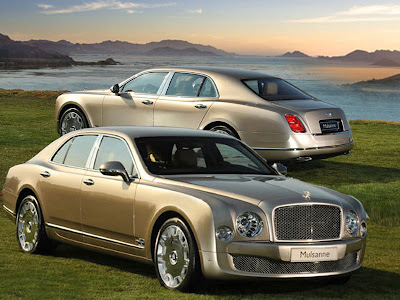
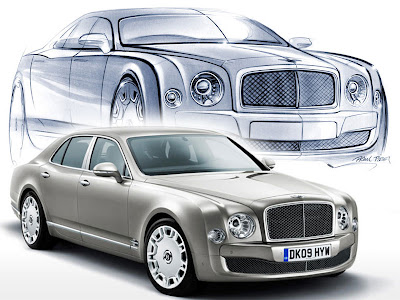
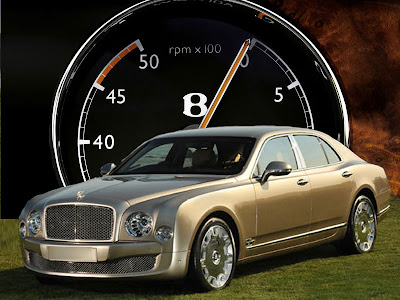
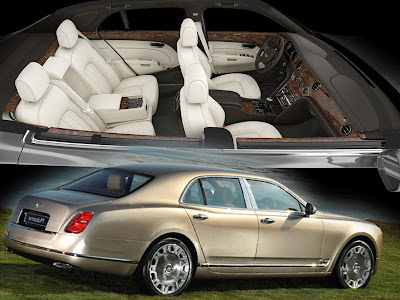
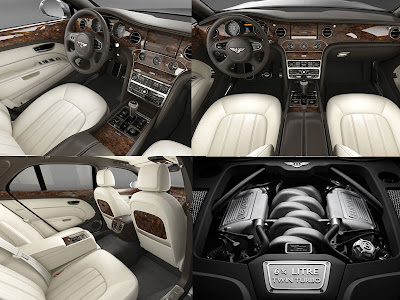
2010 New Bentley Mulsanne Luxurious Sports Car The 8-litre’s Debut at Pebble Beach Concours D’Elegance, California

2010 New Bentley Mulsanne Luxurious Sports Car

2010 Bentley Motors
unveiled the Mulsanne, the company’s all-new flagship grand tourer, at the prestigious Pebble Beach Concours D’Elegance in Monterey, California. The Mulsanne is inspired by the company founder W.O. Bentley’s crowning achievement in 1930, the 8-litre. And it was W.O.’s own sensitively conserved company car that shared the podium with the new Mulsanne in Pebble Beach. This early motoring masterpiece represented the last big Bentley that was designed, engineered and built from the ground up by Bentley engineers - until now.
2010 New Bentley Mulsanne Luxurious Sports Car

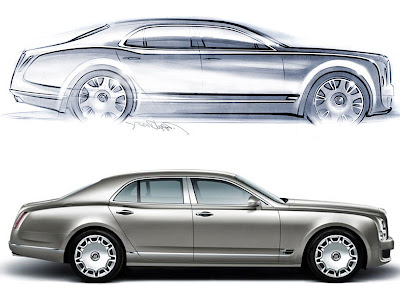
Nearly 80 years later, while paying respect to this illustrious past, the new Mulsanne is a thoroughly modern statement of luxury driving and grand touring. Conceived, styled and engineered entirely at Bentley’s headquarters in Crewe, England, the Mulsanne, with its completely new and unique platform, goes into production next year in a new state-of-the-art manufacturing facility within the Crewe factory. The Bentley design team, lead by Dirk van Braeckel, have created a flagship that offers the classic sporting, styling cues long-associated with Bentley - expressed in a thoroughly contemporary way.
2010 New Bentley Mulsanne Luxurious Sports Car

The return of the Mulsanne name to a car carrying Bentley’s iconic ‘Winged B’ emblem underlines the company’s racing pedigree and nowhere reflects that heritage better than the famed Le Mans circuit, the scene of no fewer than six Bentley triumphs. Few places offer a stronger or more emotive connection with the Bentley marque than the famed Mulsanne corner.
The Bentley 8-litre displayed alongside the Mulsanne in California was first shown at the 1930 London Motor Show.
2010 New Bentley Mulsanne Luxurious Sports Car

It was the second-built and was W.O. Bentley’s company car for two years. Capable of reaching more than 100 mph, the 8-litre demonstrated W.O. Bentley’s ambition and ability to build a grand luxury car capable of surpassing every other leading manufacturer of the day. A total of 100 cars were built in 1930 and 1931.
2010 New Bentley Mulsanne Luxurious Sports Car

“The 8-litre’s breathtaking performance and quality was perhaps the finest example of a ‘pure’ grand Bentley. Every mechanical detail carried W.O. Bentley’s unique stamp and it was the clearest demonstration of a car built without compromise,” commented Dr. Ulrich Eichhorn, Member of the Board Engineering. “The Mulsanne has been designed with exactly the same guiding principles, so it is entirely fitting that these Bentleys from different eras share the same stage.”
2010 New Bentley Mulsanne Luxurious Sports Car

The Bentley Mulsanne will go on sale from mid 2010. It will also be displayed at the forthcoming IAA Frankfurt Motor Show (15-27th September, 2009) where Bentley Motors will provide additional product information.


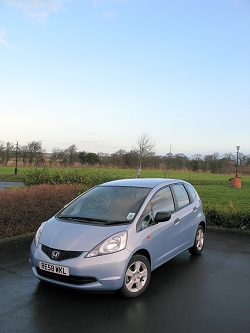
HONDA JAZZ 2009

Honda Jazz 2009
                                                                    

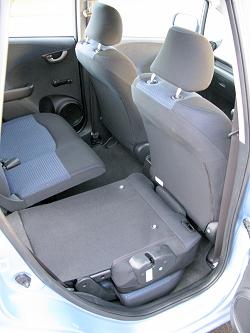
You probably know the spiel by now, but just in case, the previous Jazz sold by the shed load and had the highest customer retention numbers in the class. It was also highly favoured by the sexagenarian set, with an average buyer age of 64. This was largely down to its prodigious-ness in the fields of being spacious, well built and easy to live with. So, in an astonishingly sensible display of Japanese business planning, the new model builds on those strengths; it's now bigger and even more versatile. The one-box shape remains, though it's been given a vague makeover that will probably be neither here nor there to most eyes.


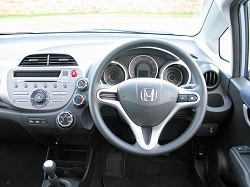
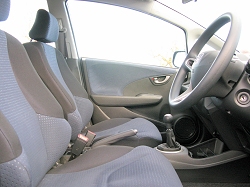
The cabin is refreshed similarly. It's very well built - albeit from hard plastics - and the view out is from a lofty perspective. The window line is low, giving good all-around visibility, though the blind spots at the A- and C-pillars are massive. That said, all the controls are chunky and placed within inches of hands placed exactly at the ten and two o'clock positions.


You probably know the spiel by now, but just in case, the previous Jazz sold by the shed load and had the highest customer retention numbers in the class. It was also highly favoured by the sexagenarian set, with an average buyer age of 64. This was largely down to its prodigious-ness in the fields of being spacious, well built and easy to live with. So, in an astonishingly sensible display of Japanese business planning, the new model builds on those strengths; it's now bigger and even more versatile. The one-box shape remains, though it's been given a vague makeover that will probably be neither here nor there to most eyes.


The cabin is refreshed similarly. It's very well built - albeit from hard plastics - and the view out is from a lofty perspective. The window line is low, giving good all-around visibility, though the blind spots at the A- and C-pillars are massive. That said, all the controls are chunky and placed within inches of hands placed exactly at the ten and two o'clock positions.
Engine & Transmission
                                           

The 89bhp 1.2-litre i-VTEC engine our test car came with feels weak, and its distinct lack of torque (84lb.ft at 4,900rpm) makes the Jazz feel heavy around town. That bugbear is alleviated by two things: a well-weighted, mechanical-feeling gear change that's a pleasure to work; and a willingness to rev freely (albeit slowly) well past 6,000rpm. It's nowhere near quick, but it's economical (53.3mpg) and clean (125g/km CO2).

Ride & Handling


The tranquillity at idle is at odds with the racket the Jazz serves up on the motorway, however. Wind and engine noise at higher speeds are a constant reminder that the Jazz is, despite its gargantuan inner quarters, a city car. Din swirls around the cabin, and the high-sided Jazz tends to get battered by even slight motorway crosswinds. The ride too, though much improved over the last-car's jarring setup, still gets fidgety over bumps. It's mostly comfortable, just easily upset.

It's futile talking at too much length about the Jazz's steering - it is, after all, a car whose remit is space and versatility, not driving prowess. However, handling is as confidence inspiring as the average pre-election promise - the first two inches of travel at either side of the steering wheel don't turn the car so much as tilt the entire body in the opposite direction. The Jazz is, all in all, a pretty uninspiring car to drive. You'd never take it out just for the sake of it.

Equipment, Economy & Value for Money


Value for money is relative, and although the Jazz has quite a high list price (our car came in at £11,131, even though its metallic 'blue rinse' paintjob was the only option), it enjoys class leading residuals. Honda dealers are unlikely to offer a significant discount on the Jazz either, though yours should comfortably last the duration of ownership without developing the irritating mechanical and trim foibles associated with some of its supermini rivals.


Economy is good (assuming you resist the urge to thrash it), and the equipment of the SE spec car we drove is satisfying enough - with alloys, air conditioning, an AUX socket for your iPod (yet nowhere to put it - why do makers do that?). There's also a plethora of airbags and electronic driving nannies to keep you feeling nice and safe.
Overall


The new Honda Jazz smacks of a car made solely for the business of getting from point A to point B as effectively as possible, and it succeeds in doing so in a resounding fashion. For the 90 percent of car buyers who value the advantages of a spacious, well made, comfortable, reasonably priced and unpretentious car, the Jazz is brilliant. The last version's success is testament to that - and this one's better still. On that basis it's a four-star car, easily.
SOURCE:carenthusiast.com
suzuki kizashi 2010

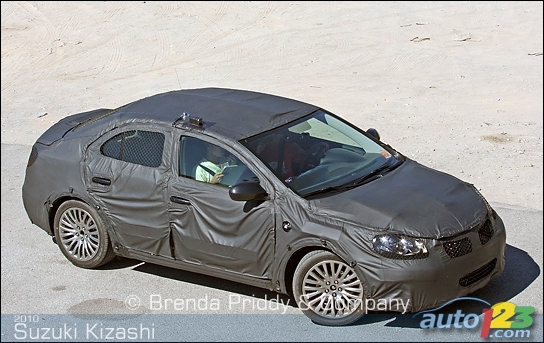
Suzuki Kizashi 2010


Built at Suzuki's brand-new manufacturing facility in Sagara, Japan, the 2010 Kizashi is equipped with a standard 2.4-liter DOHC inline four-cylinder engine offering a more potent standard engine than many competitive best-sellers. The engine employs both an aluminum block and cylinder heads, providing a lightweight installation; aluminum pistons with low tensile force rings deliver improved power and efficiency. Dropped-forged connecting rods, rotating on a forged steel crankshaft, contribute to the inline four's durability, and a balancer shaft delivers improved engine balance and reduced noise, vibration and harshness (NVH).


The responsive inline four is connected to a six-speed manual transmission, for heightened performance in the low gears, along with relaxed — and economical — cruising capability in the higher gears. Customers may opt for an available Continuously Variable Transmission (CVT) that delivers both the driving experience and fuel efficiency today's consumers demand, while not compromising the character preferred by driving enthusiasts. That character is enhanced with paddle shifters, optimizing driver control regardless of speed or driving environment. With either transmission choice, the Suzuki Kizashi is engineered to return competitive fuel economy numbers for fuel-conscious consumers.


In addition to this excellent new powertrain, and to even further enhance the Suzuki Kizashi's strong efficiency story, Suzuki is developing an even more fuel efficient hybrid version that will be added to the lineup in the future.

Design


Suzuki Kizashi's thoughtfully crafted exterior design is best described as the seamless melding of European style and Japanese craftsmanship. Tailored for the driving enthusiast, Suzuki Kizashi's bold and aggressive stance is complemented by available 18-inch alloy wheels; contemporary styling — with its lean proportion and minimal front overhang — injects the sophistication appropriate to a performance-oriented sport sedan. As with the Suzuki Kizashi Concept series, the front end of the production Suzuki Kizashi expresses both strength and style, while the vehicle's impeccably engineered body reflects Suzuki Kizashi's underlying strength and distinctive combination of capability and refinement.
At Suzuki Kizashi's rear, the architecture accentuates the 'sport' aspect of Suzuki's sport sedan. The visual dynamic is enhanced with the addition of an integrated dual sport exhaust, communicating — both visually and aurally — the Suzuki Kizashi's performance-imbued spirit.

The all-new Suzuki Kizashi includes a class-leading list of standard safety equipment, including class-exclusive standard eight airbags, Electronic Stability Program (ESP®), an anti-lock braking system with electronic brake-force distribution, projector beam headlamps and a tire pressure monitoring system.
Also included as equipment on the Kizashi is Suzuki's developed synergetic vehicle dynamic control. This system assists drivers control and a fun-to-drive experience with minimal intrusiveness.


Suzuki Kizashi is offered with Suzuki's next generation i-AWD system, a rare option in its class, as this safety and performance enhancing feature is more typically found among luxury sport sedan offerings. Engineered to provide outstanding traction in inclement weather, the sophisticated all-wheel-drive system also delivers enhanced cornering capabilities. Activated when the driver selects the "AWD" switch on the instrument panel, power to the rear wheels starts immediately upon acceleration. Torque split remains dependent on several factors, including wheel slippage and throttle input.